My writing process – how I outline a book

Updated: Dec 16, 2025
In the second of my blog posts on writing tips and advice, I thought I’d share with you the plotting part of my writing process, and everything I do before I start writing a single word of the story. It’s actually quite a lot!
Online, writers talk about being a plotter or a pantser, and I’m definitely the former! But more on that later.
Where my ideas come from

First and foremost, reading helps. It can help spark my creativity and sets my mind wandering through different scenarios.
Once I have the seed of an idea, I’ll mull it over for a while. That means I’ll think about the main character(s), what it is that they want, who they interact with, possible friendships, dialogues, anything that gets me closer to a concrete story idea.
Weirdly enough, I find doing jigsaws helps me at this stage, whether it’s online or a physical puzzle. When I’m doing them, I usually listen to music and my mind empties of all other daily stresses, which helps me think about my idea and my characters, and really get to know them.
How I plot and outline a book (plotter vs. pantser)

If you’re a writer, this is a debate you’ll likely have come across while wandering around the internet. If you’re a reader, this might be new to you.
In any case, most writers can be categorised as a plotter (someone who plots their story carefully and knows exactly where it’s going) or a pantser, or someone who “flies by the seat of their pants” (no real plot outline, writes scenes out of order).
However, there are nuances to it and I love this little table that circulates on Twitter/X every once in a while:

If I had to describe myself, I think I’d fall somewhere between “Lawful Plantser,” “Neutral Plotter,” and “Lawful Plotter”. I use character bios, and my story outlines end up being quite a detailed Excel spreadsheet organised by chapters with various columns for descriptions, character development, plot development and more, but I also like using beat sheets sometimes, and I’m not afraid to make changes or update my outline along the way.
The seven main plot points

I quoted an article in my very first blog post that discusses plot points, and this is the structure I’ve used when planning all of my novels so far. Basically, they consist of:
- A hook
- First plot point
- First pinch point
- Midpoint
- Final pinch point
- Final plot point
- Resolution
So, the hook is what makes you, as a reader, want to read on. There has to be something in the opening pages: an emotional impact, immediate conflict, a character facing a moral dilemma. Something that makes you feel something. Something that draws you in.
The first plot point is the story’s inciting incident, or the trigger that sets the rest of the story in motion. Without this plot point, your main character’s life would continue on its merry path and they would never go off on their journey of self-discovery or their quest or whatever it is you have in mind for them.
At the first pinch point, your main character is usually faced with a choice, and this is the point at which they start actively pursuing a goal.
Next, comes the midpoint. As you might expect, this is the middle of your story, and it often comes in the form of another kind of turning point for your character. Depending on how things have been going for your character, it can be a false victory or a false defeat, and may result in them having a new goal.
At the final pinch point, the stakes in your novel are raised further and often requires a new plan from your character.
The final plot point is also known as the “All is lost” moment for your character. This is where they hit their lowest point and must re-evaluate everything – including themselves!
Lastly, the resolution is the climax of your novel. The main conflict may be resolved, but most importantly your character will have changed and learned something about themselves over the course of the book.
When it comes to writing my novels, I like to map out these plot points with the key events in my stories. These then act as my landmarks in my writing process. I know I have to get from point A to point B to point C, and so on, which makes the writing in between them much easier (in my opinion and experience) and I find I spend less time rambling and writing my way into the story, using excess words.
Planning my characters

After I have my basic story outline, I start shaping my characters fully. This means turning to the writing craft books I mentioned in my last blog post.
I start by giving each of my main characters, or my main character and the most important secondary characters or antagonists, an emotional wound. Something that happened to them in their past that made them the way they are today. Something that shaped them, gave them false beliefs about themselves, positive and negative traits, and affects how they react to the world around them.
After I do this, I use the GMC (Goal Motivation Conflict) tables I mentioned in that post, and which I discovered in one of those writing craft books. I create a table for each of my key characters, highlighting what it is they want, what reasons they have for wanting that, and what stops them achieving that, both in terms of internal goals and external goals.
At this point, I usually prepare a general character sheet where I keep track of all the characters that appear in my story, with an entry for each one that includes their name, age, appearance and any defining tics (in their speech or actions), and any specific items they carry, wear or use. This document grows as the novel progresses and more characters appear.
Save the Cat!
After I have my characters nailed down, I return to my plot points and I start to fill in the gaps between these “landmarks”. For The Cards We’re Dealt, I didn’t do this step on paper as I’d dreamed about those characters for years before I started writing and I didn’t feel I needed to, but I have done this step for my subsequent books.
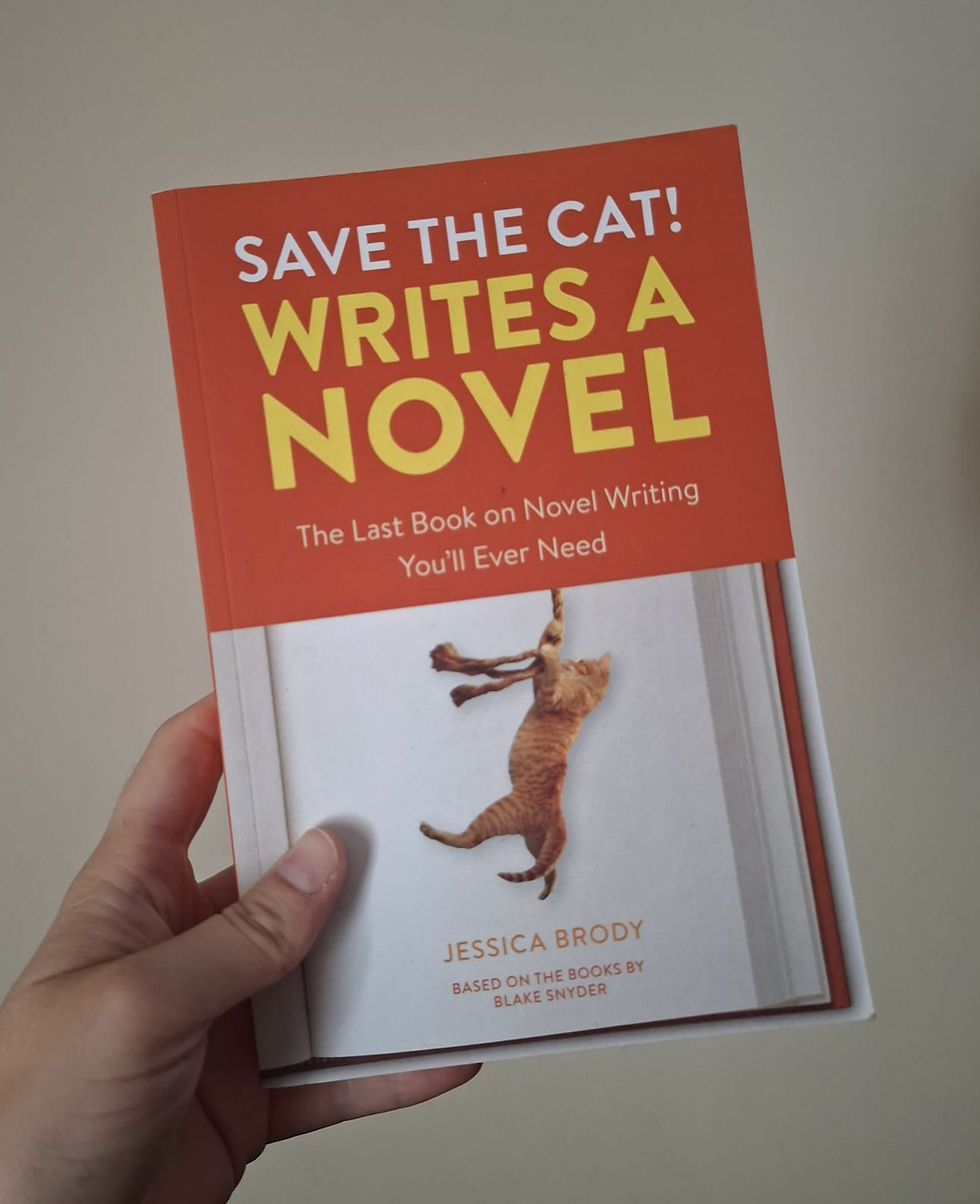
To do this, I turn to another writing craft book, also mentioned in my last blog post. Save the Cat! Writes a Novel: The Last Book on Novel Writing You’ll Ever Need uses a 15-plot point (or beat) structure that helps me plan out what goes between each of the seven main plot points I’ve already mapped out.
Depending on the novel, I might create more than one “beat sheet” with the fifteen plot points. For example, for my book club fiction novel I have in progress about two sisters I’ve created a 15-point beat sheet for each sister. Some of the plot points overlap as they are shared events, but others diverge as each sister goes on their own journey.
Romancing the Beat

For the sports romance I’ve written (and which I may look to self-publish later this year!), I used a plotting structure similar to Save the Cat!. This one is known as Romancing the Beat, and is often used by romance writers.
It’s similar to the plotting structure I use, as it still has the seven main plot points mentioned above, but in total it uses a 20-beat structure. But I’ll save more on that one for a future blog post!
Then comes my wonderful Excel spreadsheet!

After I’ve done all of these steps, I then start filling in my Excel spreadsheet. I’ll go into more depth about this another day as I think it’s a work of art in itself, haha, and it's my most crucial resource when it comes to outlining a book. But, in its essence, it’s a place where I can go when I’m writing my novel to check what’s happening in the scene/chapter I’m writing.
I have different columns for act, chapter, title (I use these for myself when writing but often remove them when editing after), location, the plot point or Save the Cat beat, a general description, plot development, character development, GMC, themes, the timeline, wordcount, and status. I then dress it up with pretty colours to leave it looking *chef’s kiss*.
I’ve also used Lucid to plan the romantic fantasy novel I’m currently writing. This website gives you a giant board where you can put sticky notes all over the place. Since I’m writing this book as the first in a trilogy with multiple key characters, I had to get my trilogy plot points clear first, before then doing the same for the first book. And within the first book, I have five key characters with their own stories who needed their own colour of sticky notes. It was a much more visual way for me to organise my thoughts and move scenes around before settling on a preferred order and transferring everything into my Excel spreadsheet.
Leaving wiggle room

Of course, when it comes to writing my stories, I always give myself freedom to stray from the outline I’ve created and I update it as I go or when new ideas or scenes come to me, or I need to make changes.
I love the planning and plotting process, but I’m never beholden to my outline!
Writers, let me know what your planning process looks like. Are you a plotter or a pantser? Or do you fall somewhere in between?
If you haven’t already, make sure you sign up for my updates and monthly newsletter using the form below on this page. You can also follow me on Twitter/X (@RhiMacG), Instagram (@rhian_writes) and Goodreads.
And if you haven’t got yourself a copy of The Cards We’re Dealt yet, head to my Books section and pick your preferred marketplace. Thanks, and see you soon!


Comments